Garden Tiger Moth
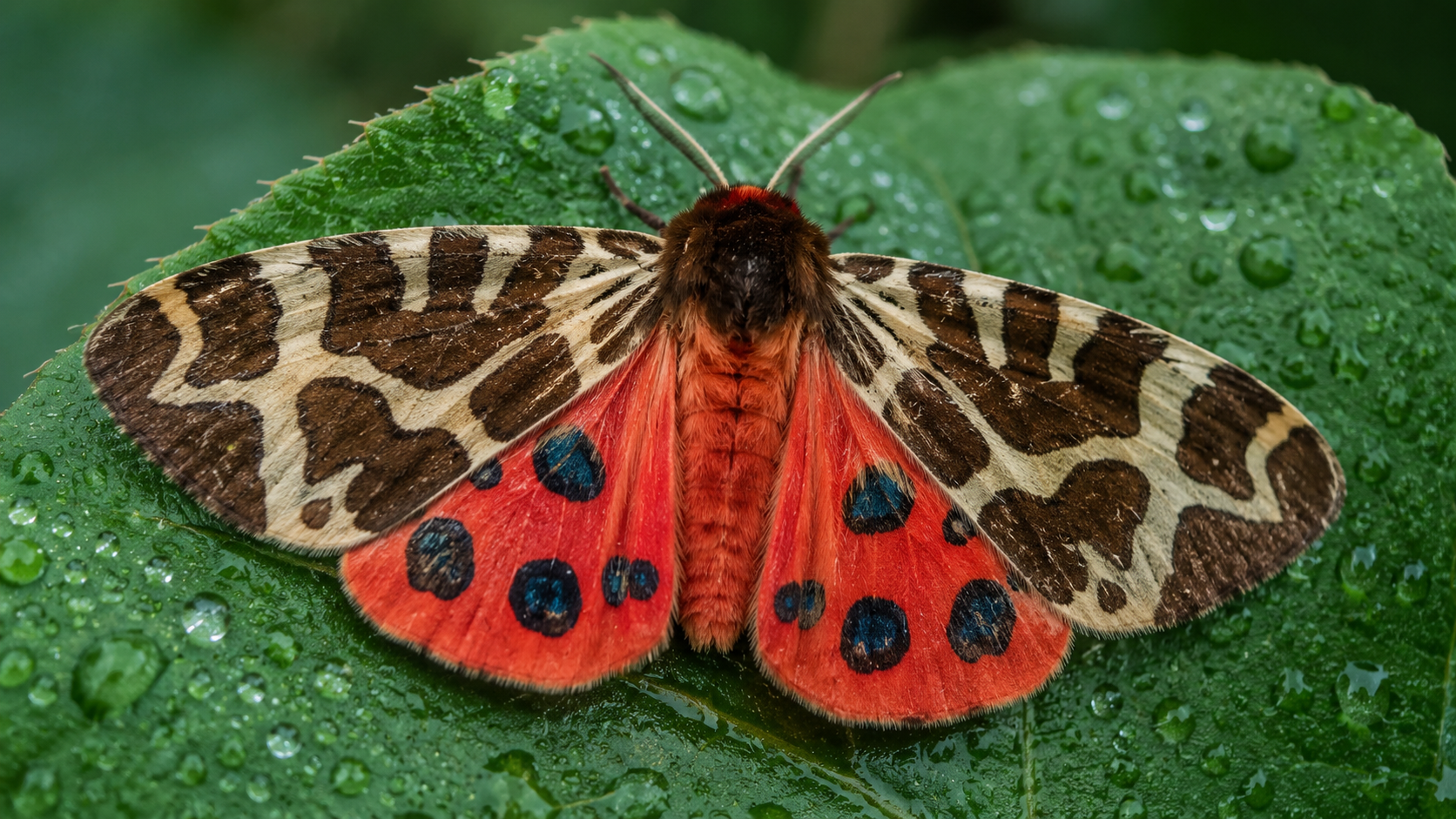
The garden tiger moth (Arctia caja): brown-splashed forewings, scarlet warning hindwings. Its woolly bear caterpillar is a familiar temperate-zone larva.
Key facts
- Latin name
- Arctia caja
- Family
- Erebidae
- Wingspan
- 45–65 mm
- Flight season
- July — August
- Host plants
- Stinging nettle (Urtica dioica), Dock (Rumex species), Plantain (Plantago species), Dandelion (Taraxacum officinale), Groundsel (Senecio vulgaris), Many other low-growing herbaceous plants
- Conservation status
- LCLeast Concern
Appearance
The garden tiger moth is one of the most strikingly patterned moths in the Palearctic, with a colour scheme that operates on two levels: camouflage when at rest, warning display when disturbed.
Forewings: The forewing ground colour is creamy white to warm buff, overlaid with an irregular pattern of dark chocolate-brown markings that are unique to each individual — no two garden tiger moths have identical forewing patterns. The markings are distributed as blotches, bands, and spots that break up the moth's outline against tree bark, lichen-covered stone, and dead vegetation. This individual variation has made the garden tiger moth a model organism in studies of natural selection operating on variable populations.
Hindwings: Entirely hidden when the moth is at rest, the hindwings are vivid scarlet-red (occasionally orange-yellow in rare variants) with four or five large blue-black spots ringed with white. The contrast between the dark forewing and the brilliant hindwing is extreme — when revealed, the hindwing pattern is visually shocking after the camouflage of the forewing.
Body: The abdomen is orange-red, marked with a line of black dots — continuous aposematic warning colouration visible when the hindwings are raised. The thorax is dark brown above, and in some individuals has a distinctive white-spotted pattern. The head and shoulders are dark brown with a white collar.
Wingspan ranges from 45 to 65 mm, with females generally larger than males.
Range
The garden tiger moth is a Holarctic species — its range spans the temperate and boreal zones of both the Old and New Worlds:
- Europe: from the British Isles and Scandinavia (to 70°N in Norway) south to the Mediterranean; widespread throughout, though showing signs of decline in oceanic western areas
- Asia: across temperate Russia, Siberia, the Caucasus, Central Asia, northern China, Korea, Japan
- North America: across Canada and the northern United States, where it was long treated as a separate subspecies (Arctia caja americana) before being synonymised with the nominate
It is absent from the tropics and subtropics, and from true desert and high-arctic zones. In mountains it ascends to approximately 2,000 m.
Life cycle
Egg and early larva
Eggs are laid in large batches of 100–300 on the underside of leaves of the larval host plant in July–August. The female deposits a single mass, often covering a significant area of the leaf underside. Eggs hatch in approximately two weeks, and the tiny first-instar caterpillars initially feed gregariously before dispersing.
The woolly bear caterpillar
The caterpillar is the most conspicuous stage of the life cycle and the most familiar to the general public. Fully grown, it reaches 55–70 mm in length — a substantial caterpillar that is impossible to overlook.
The body is covered with dense, long, mixed black and rusty-orange bristles (setae) arranged in tufts along the length of the body. The head capsule is black and shiny. The dark, hairy appearance gave rise to the "woolly bear" name, shared in North America with several related Arctia species.
Overwintering behaviour: The caterpillar hatches in August or September and feeds for several weeks before the onset of cold weather. It then overwinters as a half-grown larva — hibernating in a sheltered position in dead vegetation, leaf litter, or under stones. In spring, it resumes feeding and grows rapidly through the remaining instars, reaching full size by May or early June.
Diet: The woolly bear caterpillar is highly polyphagous — it will accept an extraordinarily wide range of low-growing herbaceous plants, including nettle (Urtica dioica), dock (Rumex), plantain (Plantago), dandelion (Taraxacum), groundsel (Senecio), comfrey (Symphytum), and many others. This polyphagy makes it one of the few moth caterpillars truly at home in disturbed, weedy habitats — roadside verges, waste ground, and gardens.
Hair irritation: The long setae of the woolly bear are mildly urticating — they can cause skin irritation or eye inflammation in humans who handle the caterpillar carelessly. Predators that attempt to eat the caterpillar encounter these hairs in their mouths and throats, and birds in particular often abandon woolly bear caterpillars after initial contact. Some birds have learned to roll the caterpillar on the ground to remove or mat down the bristles before eating — a behaviour observed in rooks and magpies.
Pupa
The caterpillar pupates in a cocoon constructed partly of its own shed hairs (incorporated into a loose silk structure) among dead vegetation at ground level. The pupal stage lasts 3–4 weeks, producing the adult in July.
Adult
Adults are nocturnal, flying from late July through August and into September in the south of the range. They come readily to artificial light. Adults have functional eyes and use acoustic bat-avoidance behaviour (producing ultrasonic clicks from the tymbal organ on the metathorax to jam bat sonar — a system widespread in Arctiinae). In this, as in their toxicity, they resemble bees and wasps in the effectiveness of their defences.
Adults do not feed — they have vestigial mouthparts insufficient for liquid uptake — and live entirely on larval fat reserves for their brief adult life.
Defence systems
The garden tiger moth has one of the most comprehensive chemical defence systems of any European moth:
- Chemical sequestration: the larva accumulates plant-derived compounds (pyrrolizidine alkaloids from Senecio and related plants) that are retained in the adult
- De novo synthesis: adults can also produce pyrazines independently, supplementing sequestered compounds
- Defensive froth: when seized by a predator, adults discharge a frothy secretion from thoracic glands containing these compounds — often sufficient to cause a bird to drop and reject the moth
- Flash display: abrupt revelation of the scarlet hindwing startles predators and reinforces the aposematic signal
- Acoustic warning: the tymbal clicks are not only bat-jamming signals but may also serve as acoustic aposematic signals to bats that have learned to associate the clicks with unpalatable prey
Population trends and decline
The garden tiger moth is one of the most intensively monitored moth species in Britain. Rothamsted Insect Survey light-trap data covering 1968–2007 show a decline of approximately 89% in recorded abundance — one of the most severe declines in the dataset for any once-common species.
The causes remain actively debated:
- Climate change: warmer, wetter winters appear to destabilise larval overwintering, possibly through increased fungal pathogen activity in mild, damp soil conditions
- Range contraction: the decline is most pronounced in Atlantic-climate western Britain and Ireland, suggesting that the species' western range margin is contracting as winters become milder
- Habitat loss: coarsening of grassland habitats reduces the diversity of larval host plants available
- Light pollution: as with many nocturnal insects, artificial light may disrupt adult behaviour, navigation, and mating
Despite this, the species remains common across much of continental Europe, Russia, and North America, and its global IUCN status remains Least Concern. The UK decline appears to represent a marginal population phenomenon rather than a global collapse.