Damon Blue
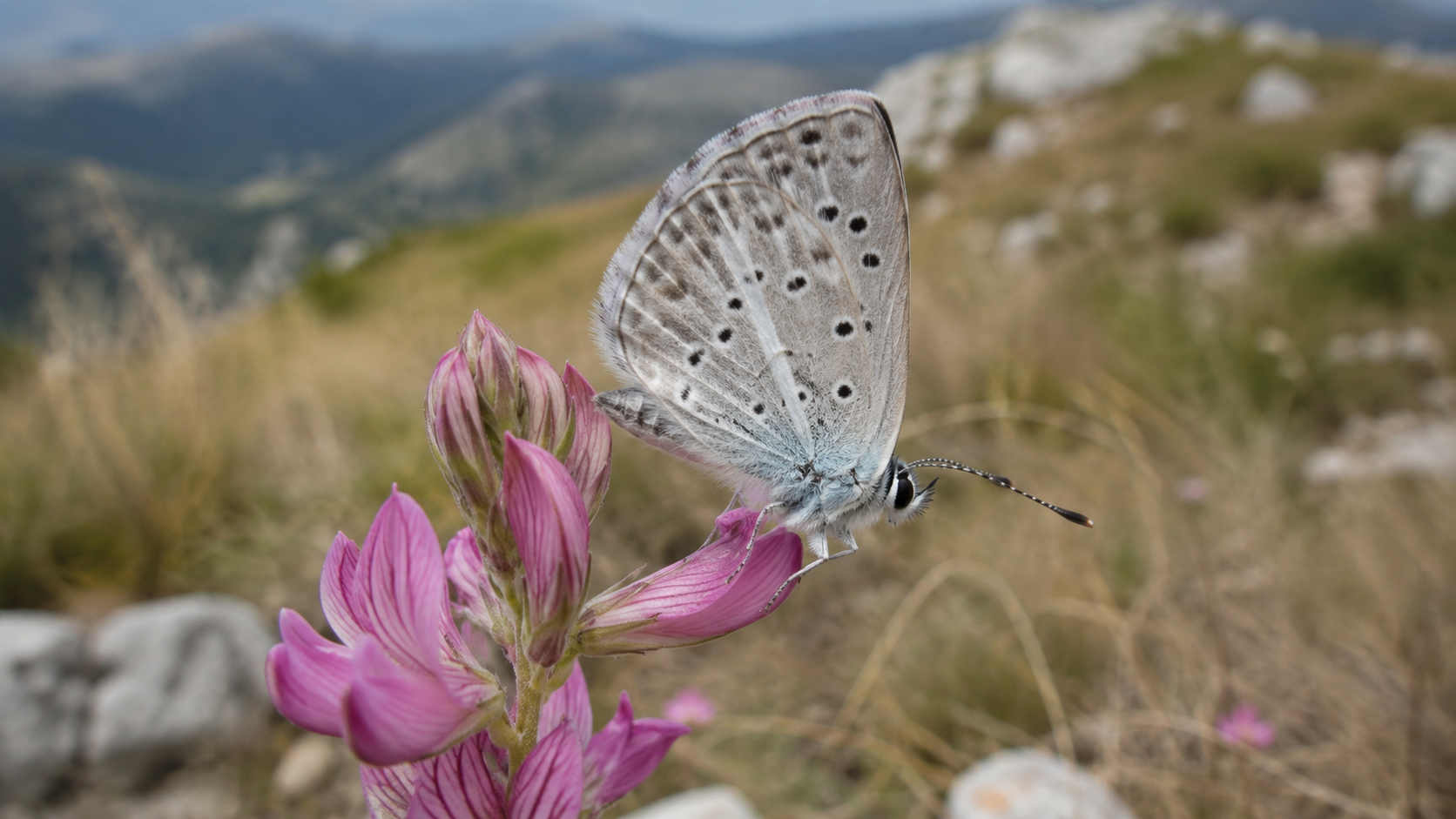
The damon blue (Polyommatus damon) is a mountain lycaenid of dry grasslands, its male marked by sky-blue wings and a white streak on the hindwing underside.
Key facts
- Latin name
- Polyommatus damon
- Family
- Lycaenidae
- Wingspan
- 30–40 mm
- Flight season
- July — August
- Host plants
- Sainfoin (Onobrychis viciifolia), Onobrychis montana, Onobrychis transcaucasica
- Conservation status
- NENot Evaluated
Appearance
The damon blue is a medium-sized lycaenid with a wingspan of 30–40 mm. It sits comfortably between the smaller common blue (Polyommatus icarus) and the larger chalk-hill blue (P. coridon) in size.
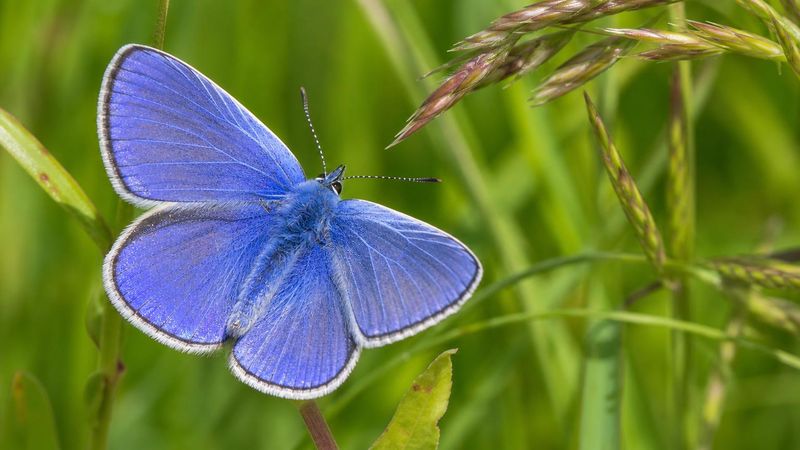
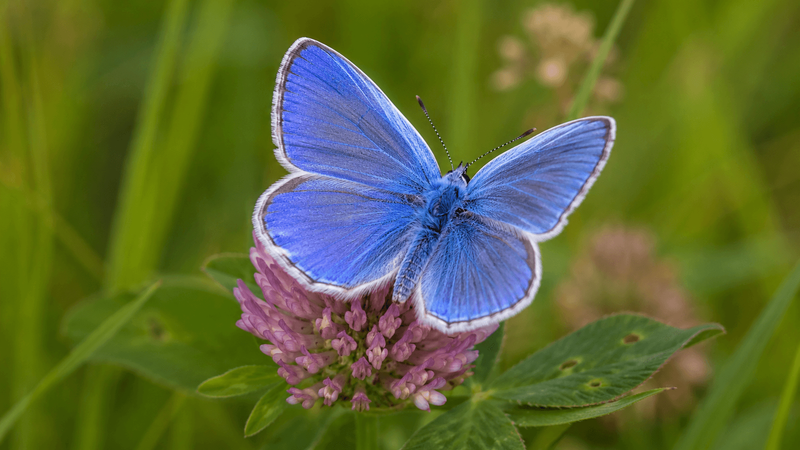
Male upperwing: Bright, clear sky-blue with a white fringe and a narrow but well-defined dark grey-brown border. The blue is slightly more saturated and less violet-tinged than the adonis blue; less grey-scaled and less shimmering than the chalk-hill blue. The upperwing of a fresh male in sunlight is striking — clean and vivid without the heavy scaling of some related species.
Female upperwing: Brown with a variable development of orange submarginal spots on both wings. Some females show a partial blue basal suffusion. The female is best identified in conjunction with the male, or by association with the distinctive underside.
Underside (both sexes): The diagnostic feature is the hindwing underside. The ground colour is pale grey-buff with the usual lycaenid pattern of black spots ringed with white. Running longitudinally from near the hindwing base toward the outer margin is a prominent white streak — elongated, fused pale marks that form a near-continuous line unlike the individual spots of related species. No European blue shares this underside character. The forewing underside is pale ochre-grey with standard black spots.
Range and habitat
The damon blue is distributed across the mountain ranges of the Western and Central Palearctic: Alps, Jura, Pyrenees, Apennines (south to Calabria), Balkans and Dinaric Alps, Carpathians, Crimea, the Caucasus range (Armenia, Georgia, Azerbaijan), Turkey, Lebanon, Iran, and the mountains of Central Asia including the Tian Shan and Kopet Dag. It is absent from the lowlands of northern and western Europe and does not reach the British Isles, Scandinavia, or the North European Plain.
The essential habitat requirement is dry, unimproved calcareous or base-rich grassland with a diverse herbaceous layer and — critically — established populations of sainfoin (Onobrychis viciifolia or montane relatives). This combination occurs reliably on:
- South-facing limestone slopes in mountain valleys
- Calcareous alpine pasture with traditional mowing or light grazing
- Rocky limestone ridges with a turf of short, stress-tolerant plants
- Warm, sheltered downland on calcareous geology, principally in southeastern Europe
The species occurs from approximately 600 m to 2,200 m altitude; the optimum is typically 1,000–1,600 m in the Alps and Balkans.
Life cycle
The damon blue is single-brooded, with adults flying from late June to early September depending on altitude and locality. At lower altitudes (600–900 m) in the Balkans, the flight period starts in late June; at 1,500–2,000 m in the Alps, the peak is typically late July to mid-August.
Eggs are laid singly at the base of sainfoin (Onobrychis) stems, usually on the soil surface rather than directly on the plant. The egg overwinters; the caterpillar hatches in spring and feeds on the flowers and developing seed pods of sainfoin, rather than the leaves. This flower-feeding habit — shared with many calcareous-grassland lycaenids — makes the species highly dependent on sainfoin being in flower or seed when caterpillars are active (May–June).
The caterpillar is attended by ants — primarily Lasius and Formica species — which extract a sugary secretion from the Newcomer's organ on the caterpillar's back. This ant-attendance relationship is facultative rather than obligate for the damon blue, unlike the highly specialised Maculinea/Phengaris blues, but it provides some protection against parasitoids.
Pupation occurs in the soil or litter, and the pupal stage lasts several weeks before adult emergence.
Behaviour
Males are conspicuous and active. They perch on sainfoin flower heads or grass stems in sunny, sheltered spots on the slope, making short darting flights to investigate passing insects and chasing rival males from the territory. Both sexes feed extensively on sainfoin nectar; knapweed, scabious, and clover are also used.
The damon blue has limited dispersal ability — most individuals remain within a patch of suitable grassland of a few hectares. This localisation, combined with the specialist habitat requirement, makes populations in isolated fragments vulnerable to extinction through stochastic events (drought, early mowing, late frost) and unable to recolonise suitable but distant habitat after local extinction.
Conservation
There is no global IUCN assessment. The 2010 European Red List treats the species as Near Threatened (NT), reflecting a documented negative trend across Europe. National red list status is more alarming in several countries:
- Germany: Vulnerable (VU) — significant range contraction since 1970
- France: Near Threatened (NT) — declining in western portions of range
- Austria: Near Threatened — stable in core Alpine sites but contracting elsewhere
The key management prescription is maintaining open, short-sward calcareous grassland with sainfoin through traditional low-intensity grazing (preferably sheep) or late hay-cutting (after early August, when adult flight is complete and pupation has begun). Early or frequent mowing destroys adults and prevents egg-laying. The cessation of grazing — common across European mountain farming — allows coarse grasses and scrub to invade within a decade, eliminating the species as effectively as ploughing.
Protected sites with appropriate agri-environment management maintain stable populations; the challenge is the unprotected matrix between reserves, where connectivity for this sedentary species is essential for long-term population viability.