Taxonomy
Taxonomy is the science of classifying organisms. Butterflies belong to order Lepidoptera; taxonomy explains why the tortoiseshell is a nymphalid, not a blue.
What is taxonomy
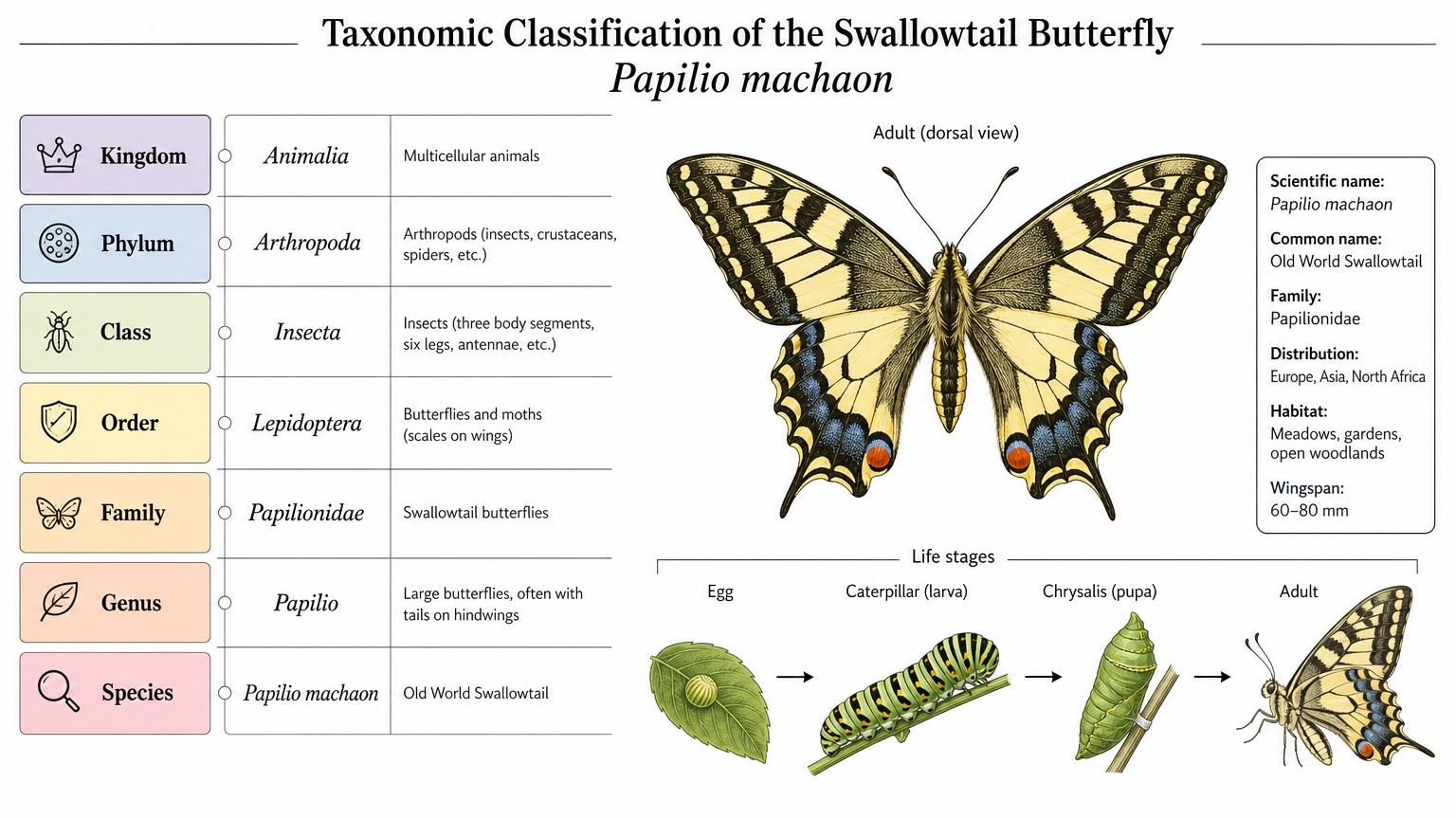
Taxonomy (from Greek taxis — order, nomos — law) is the branch of biology concerned with describing, naming, and classifying living organisms. Every organism belongs to a hierarchical system of taxa from kingdom to species.
Butterfly taxonomy helps understand relationships between species, navigate the great diversity of lepidopterans, and use a single scientific language.
Classification of butterflies
| Rank | Name | Example (swallowtail) |
|---|---|---|
| Kingdom | Animalia | Animals |
| Phylum | Arthropoda | Arthropods |
| Class | Insecta | Insects |
| Order | Lepidoptera | Lepidoptera |
| Superfamily | Papilionoidea | Papilionoidea |
| Family | Papilionidae | Swallowtails |
| Genus | Papilio | Papilio |
| Species | Papilio machaon | Swallowtail |
Main families of day-flying butterflies
Day-flying butterflies (superfamily Papilionoidea) are divided into several families:
- Swallowtails (Papilionidae) — large, often with “tails” on hindwings; swallowtail, Apollo
- Whites (Pieridae) — white and yellow butterflies; brimstone, large white, orange tip
- Nymphalids (Nymphalidae) — largest family; small tortoiseshell, red admiral, peacock, fritillaries
- Blues (Lycaenidae) — small; males often blue or copper-colored
- Satyrs (Satyridae) — brown, with eyespots; some are now placed in Nymphalidae
- Skippers (Hesperiidae) — stocky body, hooked antennae
Scientific names: why they are needed
Common butterfly names differ by language and region. The scientific binomial — genus + species — is unique and unchanged worldwide. Carl Linnaeus introduced it in the 18th century.
Example: small tortoiseshell in English, Kleiner Fuchs in German, nymphalis de l'ortie in French — but everywhere Aglais urticae (Linnaeus, 1758).
The name in parentheses after the author is the first describer and year. Parentheses around the author mean the species was moved to another genus after first description.
Taxonomy keeps changing
With molecular methods (DNA analysis) many established classifications are being revised. Some satyrs are now included in nymphalids; some “species” proved cryptic (indistinguishable externally but genetically distinct).
The full glossary is in the glossary section.