Melanism
Melanism is excess accumulation of dark pigment melanin, causing darkened coloration. Industrial melanism in the peppered moth is a classic evolution example.
What is melanism
Melanism is excess accumulation of dark pigment melanin in an animal's integument. In butterflies it appears as darkening of the wings up to nearly black coloration.
The opposite is albinism (lack of pigment). Both occur as inherited mutations and in response to environmental conditions.
Industrial melanism
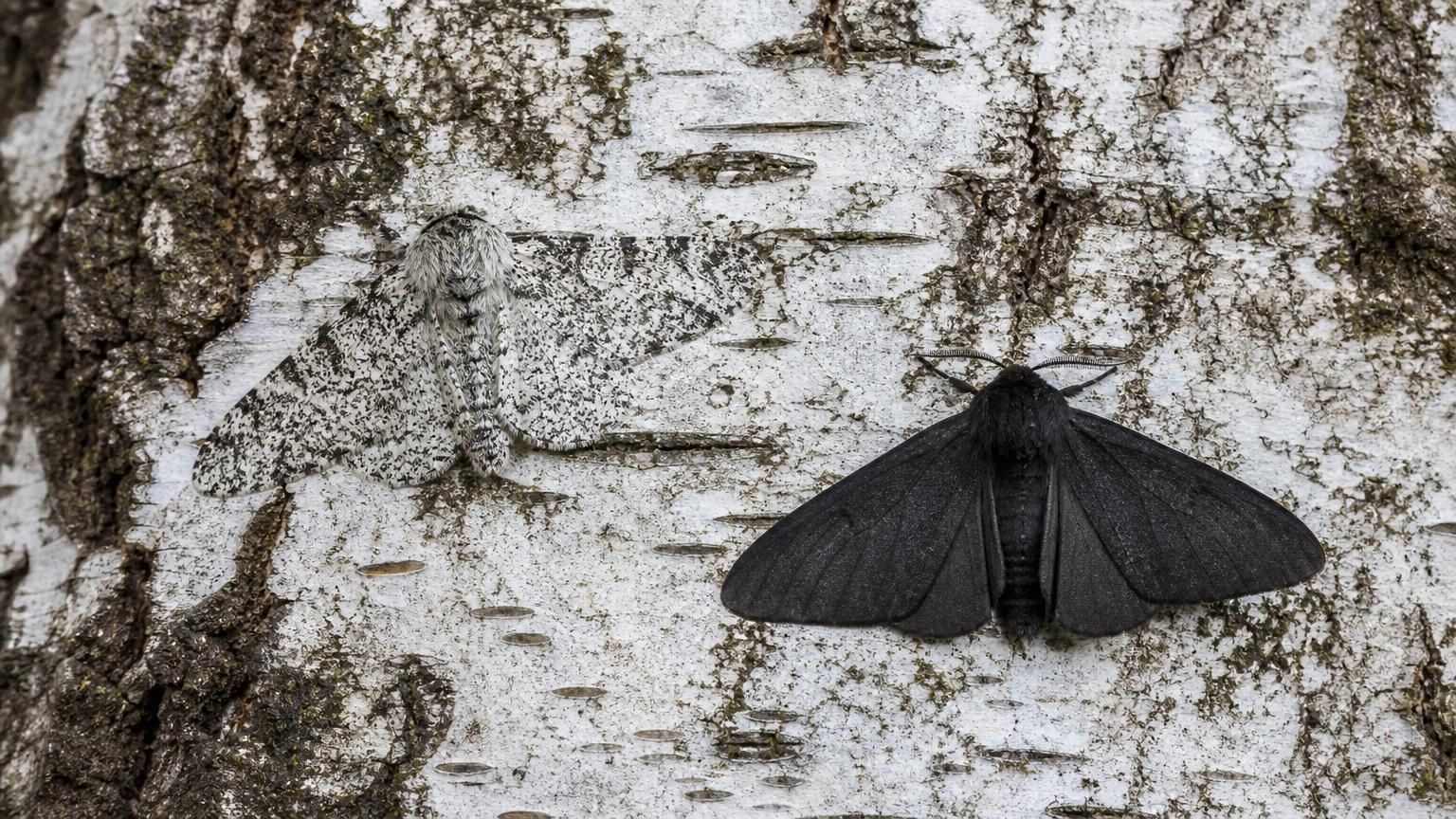
The most famous example of melanism in entomology is the peppered moth (Biston betularia) and industrial melanism.
Before the Industrial Revolution in England (18th century), most peppered moths had a white speckled pattern camouflaging them on light birch bark. The dark melanic form f. carbonaria was rare.
As industry developed, tree bark near cities became soot-covered and dark. On a dark background light moths were conspicuous to birds; dark ones were not. By the late 19th century the melanic form made up to 98% of the population in industrial areas.
This became a textbook example of natural selection: environmental change → change in selective pressure → rapid shift in allele frequencies in the population.
After clean-air laws in the 1950s–1970s birch bark lightened again, and the share of the dark form dropped.
Adaptive and non-adaptive melanism
- Adaptive melanism — the dark form improves survival (camouflage on dark background, as in the peppered moth). Maintained by natural selection.
- Sexual melanism — dark male coloration in some species attracts females (sexual selection).
- Melanism in mountain species — dark coloration absorbs more solar heat, important in cold climates. Typical of high-mountain butterflies (some fritillaries, Apollos).
- Neutral melanism — the dark form gives neither advantage nor disadvantage; persists in the population by chance (genetic drift).
Melanism and dimorphism
Melanic forms are a special case of polymorphism: light and dark forms coexist in a population. The proportion of each is set by selective pressure, which can change.
The full glossary is in the glossary section.