Sexual Selection
Sexual selection is evolution driven by mate choice or mating competition rather than survival alone — it explains many of the most extravagant colours and behaviours in butterflies.
Definition
Sexual selection is a component of evolution by natural selection that acts specifically on traits influencing an individual's success at securing mates, as opposed to traits that affect survival in general. First formally described by Charles Darwin as a way to explain traits that seemed to work against survival — bright colours that attract predators, elaborate structures that cost energy to grow and carry — sexual selection resolves the apparent paradox by showing that a mating advantage can outweigh a survival cost, as long as the net effect on reproductive success is positive.
Two mechanisms: choice and competition
Sexual selection typically operates through one or both of two mechanisms. Mate choice occurs when one sex, often females, preferentially mates with individuals displaying a particular trait — vivid colour, symmetrical pattern, a specific courtship display — driving that trait to become more elaborate over generations as choosier preferences and more extreme traits reinforce each other. Mating competition occurs when individuals of one sex, typically males, compete directly with each other for access to mates, favoring traits useful in contests: larger body size, more persistent territorial behaviour, or structures used in direct confrontation.
Among butterflies, direct physical combat is rare, but competitive interactions over territory and perches — and the visual signals used to assess a rival's condition without escalating to contact — are well documented, alongside apparent female preference for particular male wing patterns in several studied species.
Sexual selection and wing colour
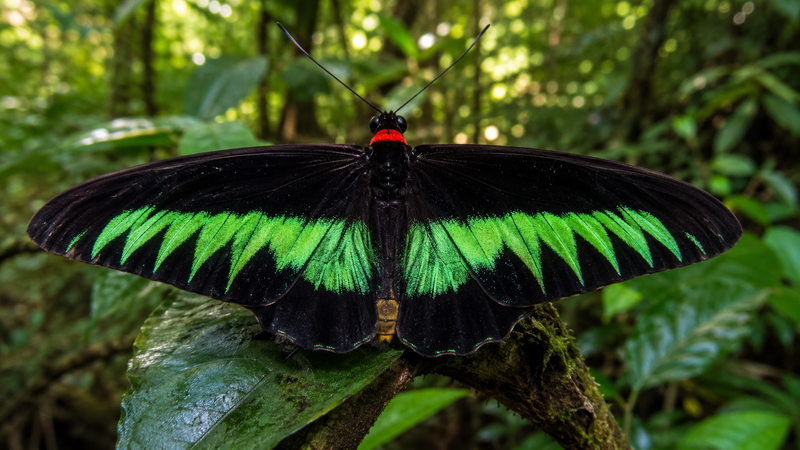
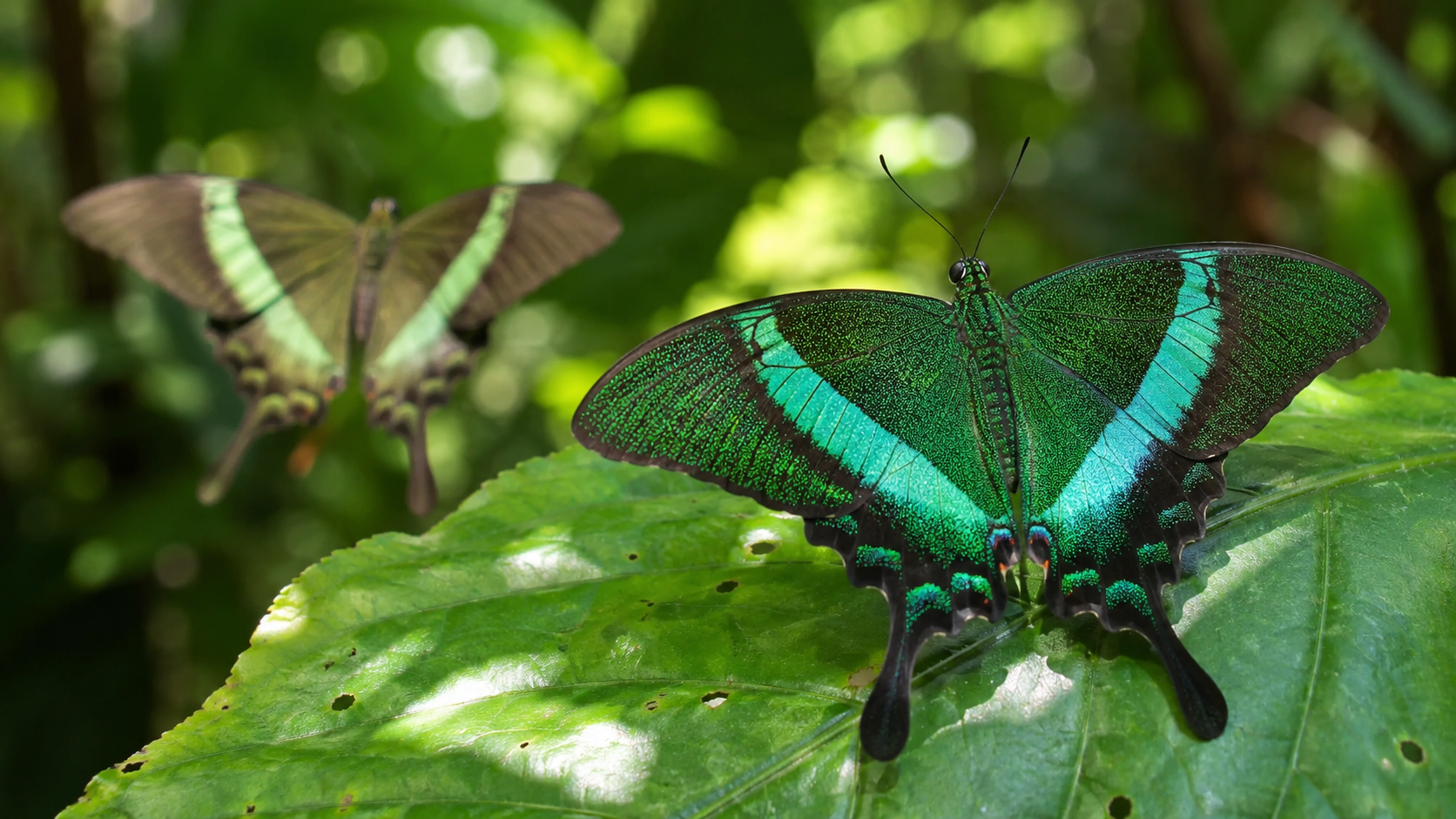
Many of the most visually striking butterfly patterns are plausible products of sexual selection. Species such as Rajah Brooke's birdwing (Ornithoptera brookiana), with its intense green iridescent bands, and the Chinese peacock (Papilio bianor), whose black wings shimmer blue-green and gold, display exactly the kind of conspicuous, energetically costly colouration that a pure survival-based model of evolution would struggle to explain on its own — but that sexual selection, through mate choice or male-male signalling, accounts for readily.
Distinguishing sexual selection from other explanations
Not every bright colour in a butterfly is necessarily the product of sexual selection — aposematic warning colour, structural colour used in thermoregulation, and species-recognition signals can all produce vivid patterns for reasons unrelated to mate choice. Researchers typically test for sexual selection specifically by looking for a sex difference in the trait (since selection pressures often differ between males and females), and by directly measuring whether individuals with more elaborate versions of the trait actually achieve higher mating success in the wild or in controlled experiments.
See also: pheromone, territorial behavior.